

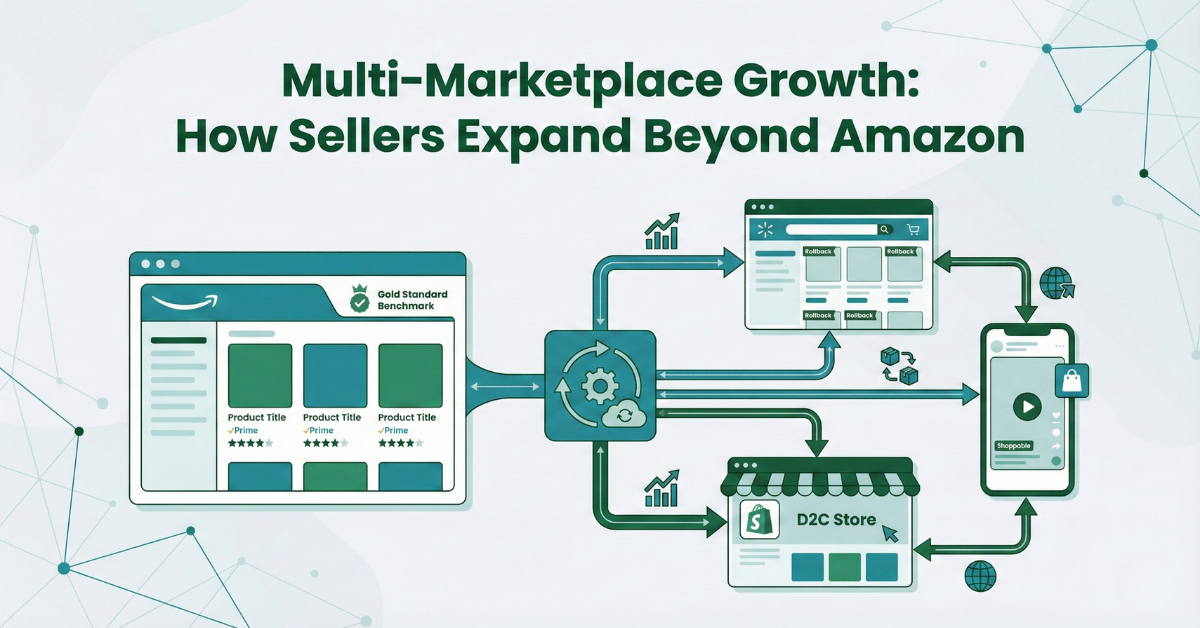
Introduction: From Single Channel to Scalable Growth
In 2025, the average online retailer is active in six marketplaces, a finding highlighted in the recent Marketplace Seller Trends Report by ChannelEngine. Notably, 67% of sellers operate on four or more platforms, and 63% of consumers prefer buying through marketplaces over standalone e-shops.
The data is clear: marketplaces dominate buyer intent.
Yet for sellers, the shift to multi-channel selling brings new challenges: manual processes, pricing conflicts, operational inefficiencies, and a steep learning curve in adapting to different marketplace demands. Despite these hurdles, Amazon remains the anchor platform. It not only drives the lion’s share of sales, but it also sets the gold standard for fulfillment, customer experience, and marketplace performance.
In this guide, we’ll break down how sellers can strategically scale beyond Amazon, overcome operational pitfalls, and use Amazon as the benchmark for growing successfully across marketplaces.
Why Amazon Still Leads (Even as Sellers Diversify)
As new marketplaces gain traction, like Walmart, TikTok Shop, and more, Amazon’s value doesn’t diminish. It evolves. Amazon remains:
- The most competitive and customer-rich environment
- A template for marketplace algorithms, logistics, and reviews
- The benchmark for seller performance and buyer expectations
For many sellers, Amazon accounts for 70–90% of their marketplace revenue. While that may decrease over time, sellers rarely walk away completely. Amazon is where shoppers search first. It’s where your product visibility, sales velocity, and credibility often begin.
The Case for Multi-Marketplace Growth
The pressure to diversify is real, and smart. Sellers now expand to reduce risk, grow customer reach, and regain margin control. But expansion isn’t about being everywhere. It’s about:
- Choosing marketplaces that align with your category and audience
- Centralizing your operations to scale effectively
- Creating a pricing and fulfillment strategy that works across channels
Key Benefits of Expanding Beyond Amazon
- Customer Acquisition: Tap into new customer segments (e.g., Gen Z on TikTok Shop)
- Margin Protection: Reduce dependence on Amazon’s rising fees
- Brand Control: Build D2C presence with platforms like Shopify
- Operational Resilience: Prevent business shutdowns in case of account suspension
Common Challenges in Multi-Channel Expansion
Despite the advantages, 27% of sellers say it’s hard to keep up with marketplace changes. The learning curve is steep, especially if you’re still relying on spreadsheets and manual updates. Here’s where sellers often struggle:
1. Inventory Sync and Overselling
Stock misalignment leads to overselling, canceled orders, and lost Buy Box visibility. Without centralized inventory, you’re at constant risk.
2. Listing Consistency
Each marketplace requires different formats, titles, and media. Brands risk losing visibility or being penalized if listings are not optimized or duplicated poorly.
3. Pricing Conflicts
Amazon may suppress your listing if the same SKU is cheaper elsewhere. A multi-channel pricing strategy must factor in marketplace fees, shipping, and buyer behavior.
4. Fulfillment Complexity
Relying solely on FBA limits your flexibility. Fulfillment options like 3PLs or Multi-Channel Fulfillment (MCF) are becoming essential to support diverse channels.
5. Marketplace Policy Risk
A single Amazon account suspension can tank your revenue. Sellers without alternative channels are vulnerable.
Amazon as a Training Ground for Marketplace Excellence
Amazon’s ecosystem, which has strict policies, complex SEO, and high buyer expectations, forces operational discipline. If you can win on Amazon, you can adapt and scale anywhere.
It teaches you:
- How to master listing optimization and conversion
- How to manage fulfillment for speed and scale
- How to analyze data for customer insights
In short, Amazon prepares sellers for broader success. It’s not just a marketplace, it’s a playbook.
Building a Scalable Multi-Marketplace Strategy
1. Start with the Right Sequence
Don’t launch on five platforms at once. Choose 1–2 that align with your niche:
- Walmart if you’re in general retail, household, or grocery
- TikTok Shop for viral potential and young audiences
- Shopify for long-term brand control and higher margins
2. Centralize Inventory and Order Management
Managing inventory across multiple platforms can quickly become chaotic without a unified system. Centralizing your operations ensures that stock levels, order processing, and product listings stay in sync, reducing errors and overselling.
Look for solutions that:
- Automatically sync inventory and orders across Amazon, your D2C store, and other channels
- Offer real-time updates to prevent stockouts or double-selling
- Provide a single dashboard for managing catalog changes and pricing updates
Whether you’re working with a developer to build custom integrations or adopting marketplace-friendly platforms, the key is automation and visibility. Sellers who streamline this early avoid major fulfillment headaches later, and set themselves up for scalable growth.
3. Diversify Fulfillment Beyond FBA
Amazon’s MCF can now serve orders from Walmart or Shopify, but beware of branding conflicts. Pair FBA with:
- Reliable 3PLs for non-Amazon fulfillment
- Walmart Fulfillment Services (WFS) for faster Walmart growth
4. Build Channel-Specific Pricing Models
Factor in:
- Fee structures (Amazon referral fees vs. Walmart vs. TikTok)
- Expected AOV per channel
- Bundle SKUs to avoid direct price comparisons
5. Standardize Core Brand Elements, Customize Format
Keep your brand voice, images, and values consistent, but adapt:
- Amazon: SEO-rich titles, A+ content
- TikTok: Shoppable videos, creator partnerships
- Shopify: Full storytelling, email capture, upsells
What Happens When You Don’t Diversify?
Let’s talk about risk. A seller doing 100% of sales on Amazon who gets their account suspended is effectively shut down. Sellers who proactively expand avoid these pitfalls:
- Revenue blackouts from platform enforcement
- Margin compression with no negotiation leverage
- Missing traffic from new channels (TikTok alone grew 500% YoY in marketplace GMV)
If Amazon is your only engine, you don’t control your business. Diversification is the antidote.
Best Tools to Manage Amazon and Shopify Together
For sellers combining Amazon with D2C, integration is everything. Use platforms that:
- Sync inventory automatically
- Unify order data and customer info
- Support custom workflows
A unified backend not only prevents costly errors like overselling or stockouts, it also frees up your team to focus on growth, not spreadsheets. Whether you build custom integrations or use marketplace-ready platforms, centralized control is the foundation for scalable multi-channel success.
Q&A: Quick Answers for Growing Sellers
What’s the best marketplace to expand to after Amazon?
It depends on your niche. Walmart is strong in general retail, TikTok Shop in viral categories, and Shopify for D2C control.
Can I use Amazon FBA to fulfill Shopify or Walmart orders?
Yes, through Multi-Channel Fulfillment (MCF). Just watch for packaging and delivery branding conflicts.
How can I avoid pricing conflicts between marketplaces?
Use bundles, variations, and channel-specific SKUs. Keep pricing aligned with each platform’s fee structure.
What happens if my Amazon account gets suspended?
Without diversification, your revenue stops. Having other channels ensures continuity and negotiation leverage.
Should I hire an agency or go DIY?
If you’re scaling fast or entering complex new channels, hiring experts like Bits & Atoms can accelerate success.
Conclusion
Succeeding on Amazon is only the beginning. The next stage is mastering multi-marketplace growth, strategically, efficiently, and with Amazon as your benchmark. The future belongs to brands that can move fast, stay agile, and meet customers wherever they shop.
Want expert help applying these strategies to your brand? Book a call with our team.