

Introduction
For years, Amazon sellers faced a simple but frustrating truth:
Sponsored Ads offered reach and results, but limited control over who exactly saw them.
You could target by keyword, product, or category, but not by actual customer behavior.
That’s now changing.
In 2025, Amazon Marketing Cloud (AMC) has become one of the most powerful tools in the Amazon Ads ecosystem. With AMC custom audiences, advertisers can now target Sponsored Ads based on real shopper interactions, not just search terms or ASINs.
This is a major shift. It allows sellers to:
- Re-engage shoppers who viewed but didn’t buy
- Upsell to previous customers
- Target new, high-value audiences based on cross-ASIN behavior
In this guide, we’ll explain what AMC audiences are, how they work with Sponsored Ads, and why they matter for your Amazon strategy. We’ll also share practical examples, limitations, and how we at Bits & Atoms use AMC to scale campaigns for our clients.
As we move into 2026, AMC audiences are becoming the backbone of Amazon’s audience-first advertising era. The brands that start building and refining their data strategies now will enter 2026 with a massive advantage, able to activate first-party insights, improve efficiency, and future-proof their campaigns against rising CPCs and signal loss.
What Are AMC Custom Audiences and Why They Matter Now
Amazon Marketing Cloud (AMC) is a privacy-safe analytics environment that lets advertisers analyze data across all Amazon Ads campaigns. Think of it as a behind-the-scenes data engine that connects the dots between every shopper interaction, from awareness to conversion.
Until recently, AMC was mostly used by advertisers running DSP (Demand-Side Platform) campaigns. That meant deep insights were reserved for bigger brands. But now, Amazon has integrated AMC audiences directly into Sponsored Ads campaigns.
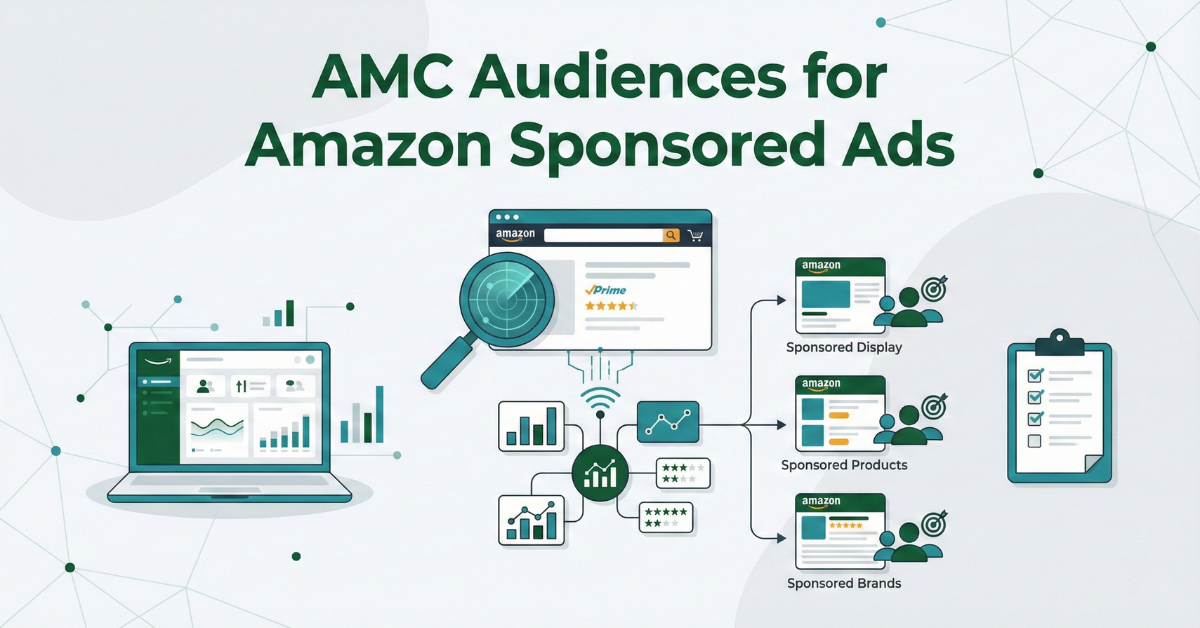
That means sellers can use AMC’s behavioral insights to build custom audiences and feed them into:
- Sponsored Display (for direct targeting)
- Sponsored Products and Sponsored Brands (for bid boosting and audience-based optimization)
It’s a major evolution. Instead of targeting based on assumptions, you can now target based on verified behavior inside Amazon’s ecosystem.
For example, a skincare brand can reach shoppers who viewed its moisturizer ad but never completed checkout. A coffee brand can target customers who bought espresso capsules but not coffee beans. These aren’t just guesses, they’re data-backed audiences.
How AMC Audiences Work Across Sponsored Ads
At its core, an AMC custom audience is a group of Amazon shoppers defined by real actions:
- Viewed a specific ASIN or ad type
- Added to cart but didn’t purchase
- Purchased from a product category
- Engaged with multiple ads over time
Once defined, these audiences can be used in Sponsored Ads in two main ways:
- Sponsored Display – Direct Targeting:
AMC audiences can be directly targeted with Sponsored Display ads. For example, you could show an ad to shoppers who viewed your product page in the last 30 days but didn’t buy. - Sponsored Products & Sponsored Brands – Bid Boosting:
Instead of replacing your keyword targeting, AMC audiences act as signals. When a shopper from your audience appears in a relevant auction, Amazon can boost your bid to increase visibility.
This dual use, direct targeting and bid optimization, creates a bridge between upper and lower-funnel strategies. You can run performance campaigns while staying audience-aware.
Currently, these capabilities are rolling out across markets, so some regions may have partial access. But in most major marketplaces (including Europe and North America), AMC audience integration is already active.
How to Create Custom Audiences in Amazon Marketing Cloud
Creating an AMC audience doesn’t require advanced SQL knowledge anymore. Amazon now provides an intuitive audience builder interface inside the Ads console.
Here’s how it works:
- Access AMC through your Amazon Ads account.
If you don’t yet have access, your Amazon representative or agency partner (like Bits & Atoms) can help set it up. - Open the audience builder.
You can choose from templates (e.g., “purchased in the last 90 days”) or build a rule-based audience from scratch. - Set behavioral rules.
Examples: shoppers who viewed but didn’t purchase; customers who purchased product A but not product B. - Choose your lookback window.
Define how far back AMC should look (7–180 days). - Activate in Sponsored Ads.
Send your audience to Sponsored Display for targeting or Sponsored Products/Brands for bid optimization. - Monitor performance in AMC reports.
Measure reach, engagement, and incremental sales across campaigns.
This is the cleanest way to connect insight and activation, all within Amazon’s own ecosystem.
AMC Audiences vs DSP Audiences
Many advertisers wonder: If I can use AMC audiences for Sponsored Ads, do I still need DSP?
The answer: both matter, but they serve different roles.
| Feature | AMC Audiences | DSP Audiences |
| Primary Use | Insights & Sponsored Ads integration | Display, video, and external inventory activation |
| Targeting Type | Custom, rule-based, behavior-driven | Amazon prebuilt segments (in-market, lifestyle, etc.) |
| Reach | Within Amazon ecosystem | On and off Amazon (web, apps, Twitch, Fire TV, etc.) |
| Control | Advertiser-defined logic | Amazon-managed targeting |
| Best For | Precision targeting and performance optimization | Awareness and upper-funnel reach |
In short, DSP helps you reach new audiences across Amazon-owned and third-party platforms, while AMC helps you understand and activate your own audiences within Sponsored Ads. Together, they form a closed loop: insight → activation → measurement.
At Bits & Atoms, we use both platforms together. DSP to expand reach, AMC to refine and optimize Sponsored Ads performance.
Practical Use Cases for AMC Audiences
Here are some of the most effective ways brands are using AMC audiences right now:
1. Re-engage browsers who didn’t buy
A home electronics seller can retarget shoppers who viewed a smart speaker but didn’t purchase within 14 days.
2. Upsell to previous buyers
A coffee brand can create an audience of past buyers of espresso machines and serve Sponsored Display ads for coffee beans or accessories.
3. Defend your brand pages
Use AMC data to identify repeat brand visitors and apply bid boosts in Sponsored Products, keeping your brand visible when high-value shoppers return.
4. Cross-promote between ASINs
A skincare brand can build a rule: “shoppers who bought cleanser A but not moisturizer B.” AMC identifies that audience, and Sponsored Ads convert it.
5. Reduce overlap and wasted spend
By analyzing campaign intersections, AMC reveals when multiple ads target the same audience. Adjusting bids prevents budget cannibalization.
Each of these use cases reflects one truth: data-led advertising beats guesswork.
How AMC Audiences Improve Sponsored Display Targeting
Sponsored Display is where AMC audiences truly shine.
Traditionally, Sponsored Display relied on Amazon’s prebuilt segments (In-Market, Lifestyle, etc.). Those are still useful, but they’re broad. With AMC, advertisers can now craft custom segments that reflect their real customers’ behavior.
For example:
- Target shoppers who viewed your product and a competitor’s product within seven days.
- Re-engage audiences who added to cart but abandoned checkout.
- Build lookalike audiences from high-value purchasers.
This precision means higher conversion rates, more efficient budgets, and smarter remarketing cycles. Sellers no longer waste impressions on low-intent audiences.
Limitations of AMC Audiences in Sponsored Ads
Even with these advantages, AMC audiences still have constraints sellers should know:
- No full negative targeting yet: You can’t exclude specific audiences within Sponsored Ads campaigns.
- Minimum audience thresholds: AMC enforces privacy-safe audience sizes (hundreds of users) before activation.
- Regional rollout: Some integrations (especially for Sponsored Products and Brands bid boosts) are still expanding globally.
- Data lag: AMC data updates daily, not in real-time, so fast-moving campaigns need thoughtful timing.
In other words, AMC isn’t a magic switch. It’s a strategic layer that rewards planning and iteration.
Best AMC Audience Strategies for Amazon Sellers
If you’re just starting, focus on building and testing two key audience types:
- High-intent retargeting audience:
Shoppers who viewed or added to cart but didn’t buy. Ideal for Sponsored Display ads. - High-value purchase audience:
Repeat customers or buyers of premium ASINs. Use this segment for Sponsored Products bid boosts or cross-selling campaigns.
As you grow, expand into layered strategies:
- Combine AMC and DSP audiences for full-funnel measurement.
- Use AMC insights to adjust keyword budgets in Sponsored Products.
- Map audience overlap across campaigns to cut inefficiencies.
At Bits & Atoms, we help brands use AMC data not just to target better, but to think smarter about ad sequencing, creative strategy, and full-funnel growth.
Learn more about our Amazon Advertising Service to see how we connect data and performance.
FAQs
Do I need DSP to access AMC audiences?
Not anymore. As of 2025, AMC is accessible directly through Amazon Ads for most advertisers, even without DSP spend.
Can I directly target AMC audiences in Sponsored Products?
In most regions, direct targeting is limited to Sponsored Display. Sponsored Products and Brands currently use bid modifiers.
How often should I refresh my AMC audiences?
Every 2-4 weeks is a good cadence to keep your audiences accurate and active.
Is AMC suitable for small brands?
Yes. Even smaller sellers can use prebuilt templates and rule-based audiences to start measuring performance more precisely.
What makes AMC different from standard Amazon Ads reports?
AMC connects data across ad types, giving a full-funnel view of customer behavior instead of last-click performance only.
Conclusion
For Amazon sellers aiming to scale efficiently in 2025 and beyond, AMC isn’t optional anymore, it’s the foundation for smarter targeting, better optimization, and long-term brand growth.
As Amazon moves deeper into 2026, we expect AMC to play an even bigger role in unified audience management, campaign automation, and AI-driven bid strategies.
If you’re not using AMC today, you’ll be catching up tomorrow.
Want to see how AMC could transform your own campaigns?
Book a call with our team at Bits & Atoms.
We’ll show you how we use AMC audience activation to help brands grow with data-backed precision.