

Introduction
Running ads on Amazon isn’t optional anymore, it’s survival. But if you’re a new or growing brand, the question isn’t just “How do I get sales?”, it’s “How do I stop losing sales to competitors and maximize the value of every shopper I already reach?”
Here’s the reality:
Every product detail page on Amazon is crowded with competitor ads. Even when a shopper lands on your listing, they’re one click away from buying something else. At the same time, rising CPCs mean you can’t afford to waste spend chasing keywords without a strategy.
That’s where cross-promo campaigns in Amazon Ads come in. These campaigns let you turn your own catalog into a growth engine. Instead of advertising each product in isolation, you use ASIN targeting to:
- Promote complementary products and bundles
- Defend your listings from competitor ads
- Cross-sell and upsell variations
- Funnel traffic from best-sellers to lower-visibility SKUs
In this guide, we’ll break down everything you need to know about cross-promo campaigns, what they are, why they matter, and how to use them strategically to boost sales, increase average order value (AOV), and strengthen your brand presence on Amazon.
What Are Cross-Promo Campaigns in Amazon Ads?
A cross-promo campaign is a type of product targeting campaign that shows ads for your own catalog, instead of relying only on keywords.
Think of it as turning your catalog into a web of opportunities:
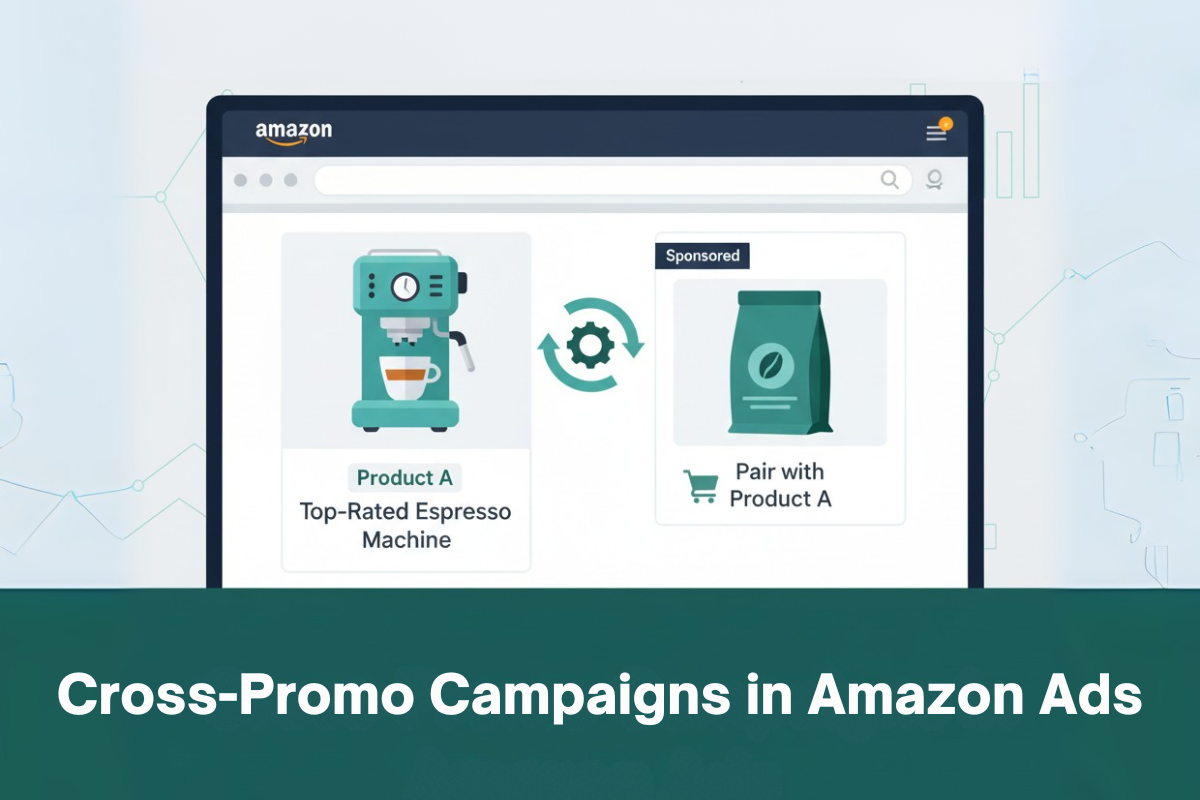
- A customer views your espresso machine → they see your branded coffee beans, milk frother, or descaler.
- A shopper browsing your best-selling dehumidifier → they also see your other models or filter replacements.
- Someone adding universal absorbent pads to their cart → they’re served an ad for your full spill kit.
The logic is simple: if you don’t promote your own products on your own pages, Amazon will happily sell that ad space to a competitor. Cross-promo ensures you own more of the real estate inside your listings while creating natural ways for shoppers to buy more from you.
Amazon Product Targeting vs. Keyword Targeting Explained
Most sellers start with keyword targeting: you bid on phrases like “best coffee machine” or “car cleaning kit” to get your product in front of searchers.

That’s great for discovery, but it leaves a blind spot, what happens once a shopper clicks into a product detail page?
That’s where product targeting comes in. Instead of competing for search terms, you target specific ASINs or categories. Your ads then show up on product detail pages, related product carousels, and sometimes even in search results when shoppers look at those ASINs.
➡ ️ Keyword targeting: Best for demand capture. Finding new customers searching for products like yours.
➡ ️ Product targeting: Best for demand defense and expansion. Protecting your pages, upselling, and cross-selling directly where shoppers make buying decisions.
The smartest Amazon PPC strategy uses both. Keywords bring traffic in, while product targeting ensures that once shoppers are looking at your products, they don’t leave without seeing the rest of your catalog.
Types of Cross-Promo Campaigns (and How to Use Them)
1. Complementary Products (Cross-Sell)
Promote products that naturally go together.
- Example: Espresso machine → coffee beans or descaler
- Example: Spill kit → absorbent pads
Strategy tip: Use this to increase AOV by making your brand the one-stop solution. Pair high-demand items with logical add-ons that improve the shopper’s experience.
2. Brand Defense Campaigns
Target your own listings with ads for other products in your catalog.
- Example: Dehumidifier Model A → ads for Dehumidifier Model B
- Example: Air Fryer 4L → ads for Air Fryer 6L
Strategy tip: This type prevents competitors from hijacking your product detail pages. Yes, you’ll pay for the clicks, but you’re also safeguarding against lost sales and keeping customers inside your brand ecosystem.
Our example:
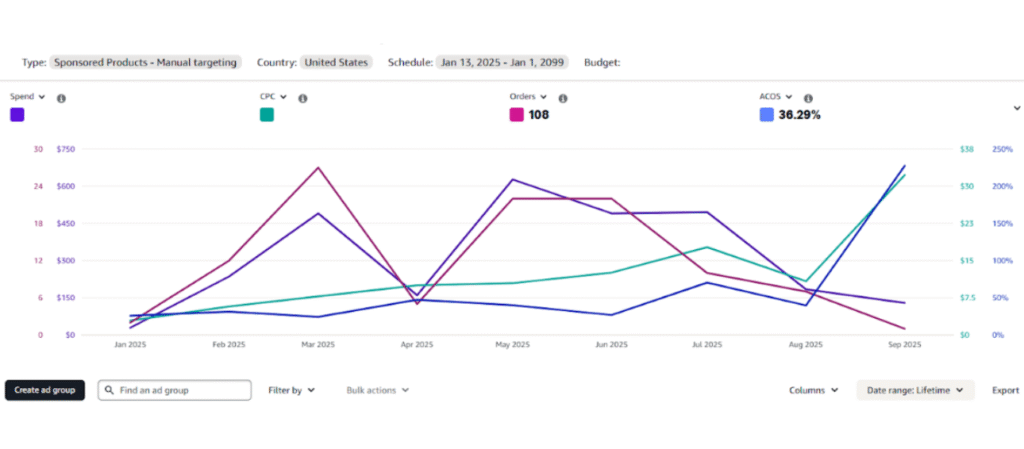
By running Sponsored Products ads from one hero product to other products in the same catalog, the brand drove over 100 orders at an ACoS of ~36%. This not only protected their detail pages from competitors but also funneled traffic toward additional SKUs. Notice how spend and orders move together, the more consistently the brand invested in defending its listings, the more incremental sales it captured across its lineup.
3. Variation-to-Variation Targeting
Promote different pack sizes, colors, or models of the same product line.
- Example: 3-pack absorbent pads → 100-pack absorbent pads
- Example: Black Yoga Mat → Blue Yoga Mat
Strategy tip: This reduces return risk by helping customers choose the right version for their needs. It also creates upsell opportunities, many shoppers will upgrade once they see the options side by side.
Our example:
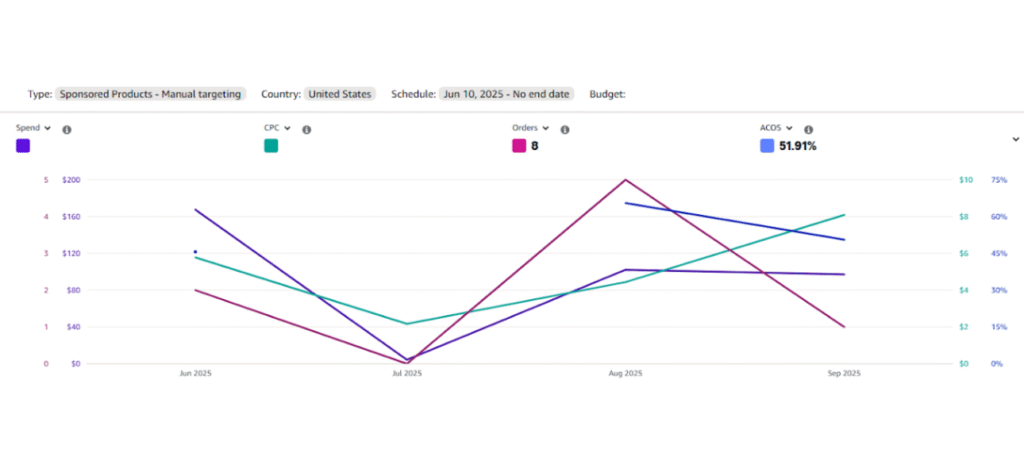
Variation cross-promo campaigns can also deliver meaningful results, but they often behave differently than broad catalog defense. In this test, targeting variation-to-variation (different pack sizes) generated 8 incremental orders with a higher ACoS (~52%). While the efficiency was lower, the strategy helped shoppers navigate to the right variation for their needs. This is key: variation cross-promo may not always be the most cost-efficient tactic, but it reduces returns, improves customer satisfaction, and ensures competitors don’t capture those undecided shoppers.
4. Self-Targeting (Product Awareness)
Run ads on the exact same ASIN.
- Example: Product A → ads for Product A
Strategy tip: This lets you dominate the ad placements on your own product page. It may feel redundant, but it ensures you own maximum visibility and block competitor intrusion.
5. Conquesting Competitor ASINs
Target competitor listings with your own products.
- Example: Customer viewing Brand X’s car polish → your ad for your detailing spray.
Strategy tip: CPCs here can be higher, and conversions tougher—but it’s a way to expand market share. Use this carefully, focusing on competitor products where you have a clear advantage (price, reviews, or features).
How Cross-Promo Campaigns Boost AOV and CLV
Cross-promo isn’t just about single-sale wins. It’s about improving the value of every customer you attract.
- Increase AOV: Shoppers who buy an espresso machine and coffee beans spend more than those who buy only one. Cross-promo campaigns make that upsell visible at the exact moment of purchase.
- Boost CLV: Past buyers are your warmest audience. Using Sponsored Display, you can re-engage them with ads for complementary products, building loyalty and repeat revenue.
- Defend Market Share: By filling ad slots with your own catalog, you prevent customers from leaking to competitors.
- Grow Low-Visibility SKUs: Pair your best-sellers with products that don’t get as much organic traction. Traffic from a hero ASIN can push sales for weaker products, improving catalog health overall.
How to Use ASIN Targeting for Cross-Selling on Amazon
Setting up a cross-promo campaign is straightforward, but success comes from precision:
- Select your hero ASINs. Start with your best-sellers, they already get traffic, so use them as gateways to cross-sell other products.
- Choose logical pairings. Use reports like Amazon’s Market Basket Analysis to identify which products customers buy together.
- Segment campaigns. Keep complementary, brand defense, and conquesting campaigns separate. This makes it easier to measure ROI and adjust budgets.
- Adjust bids by placement. Product page placements may need different bids than search results. Monitor performance and allocate budget accordingly.
- Test and iterate. Rotate which products you promote together, track AOV changes, and refine based on results.
How to Reduce Wasted Ad Spend with Product Targeting
One of the biggest concerns sellers have is wasting money on ads that don’t convert. With cross-promo campaigns, waste happens when you:
- Target irrelevant ASINs or categories
- Cross-promote products with poor reviews or weak pricing
- Fail to monitor overlap between ads and organic performance
To avoid this:
- Check relevance: Always ask, “Would I realistically buy these two products together?”
- Filter by performance: Pause targets with high clicks and low conversions.
- Use negative targeting: Exclude irrelevant products or categories to tighten your campaigns.
- Promote winners only: Make sure the cross-promoted item has strong reviews, pricing, and stock. Otherwise, you’re paying to showcase a weak link.
Upsell and Bundle Strategies with Sponsored Products
Amazon doesn’t just allow cross-promotion, it rewards it. Bundles and upsells often convert better because they align with shopper intent.
- Upsell strategies: Use ASIN targeting to move customers from a base model to a premium version. Highlight differences clearly in product titles and images.
- Bundle strategies: Create virtual bundles (if Brand Registered) and run Sponsored Products ads directly to them. Bundles organically appear on both product pages, and ads can drive additional visibility.
Pro tip: Bundles often win the “Frequently Bought Together” carousel, giving you extra free exposure. Pair this with ads and you’ve maximized your chances of capturing the add-on sale.
Expert Tips for Structuring Cross-Promo Campaigns
- Defense first: Protect your best-sellers. Losing a hero ASIN to a competitor’s ad costs more than the ad spend to defend it.
- Complement second: Promote logical add-ons that increase basket size.
- Conquest last: Allocate a smaller test budget to competitor targeting, it’s higher risk, but can unlock new market share.
- Monitor AOV, not just ACoS: Success isn’t just cheaper clicks, it’s bigger orders and more loyal customers.
- Align with seasonality: Pair core products with seasonal add-ons (filters in humid months, holiday gift bundles in Q4).
Running these campaigns at scale requires constant monitoring, bid adjustments, and ASIN-level analysis. Many sellers find cross-promo campaigns powerful, but also complex to manage on top of everything else.
At Bits & Atoms, we help brands structure, manage, and optimize their Amazon PPC through our Advertising Management Services, so that campaigns like cross-promo don’t just run, they deliver measurable growth. From building brand defense strategies to scaling complementary product ads, our team ensures your ad spend drives maximum return.
FAQs
Q1: Are cross-promo campaigns only for large brands?
No, smaller brands can benefit even more. They help defend listings and build visibility when you don’t have the same brand recognition as bigger players.
Q2: Won’t I just pay for sales I would have gotten anyway?
Not if set up strategically. The goal is to add incremental value, upselling to bigger packs, cross-selling add-ons, or defending against competitors who would otherwise take the sale.
Q3: Do cross-promo campaigns work for all product categories?
Yes, but they’re most effective in categories with natural add-ons (home, kitchen, electronics, automotive). The more logical pairings your catalog has, the stronger the results.
Q4: How much budget should I allocate to brand defense?
A general rule is 10–20% of your PPC budget. Adjust based on how competitive your category is and how much risk you face from competitor ads.
Q5: Can I automate cross-promo targeting?
Amazon won’t do this for you by default. You’ll need to set up ASIN targeting manually, but tools like Helium 10 can help you identify high-value pairings and competitor ASINs.
Conclusion
Cross-promo campaigns transform Amazon Ads from a simple “get clicks” tool into a catalog growth engine. By using ASIN targeting strategically, you can defend your listings, increase average order value, and funnel traffic from best-sellers into the rest of your lineup.
Want expert help applying these strategies to your brand? Book a call with the Bits & Atoms team and let’s scale your Amazon business smarter.